
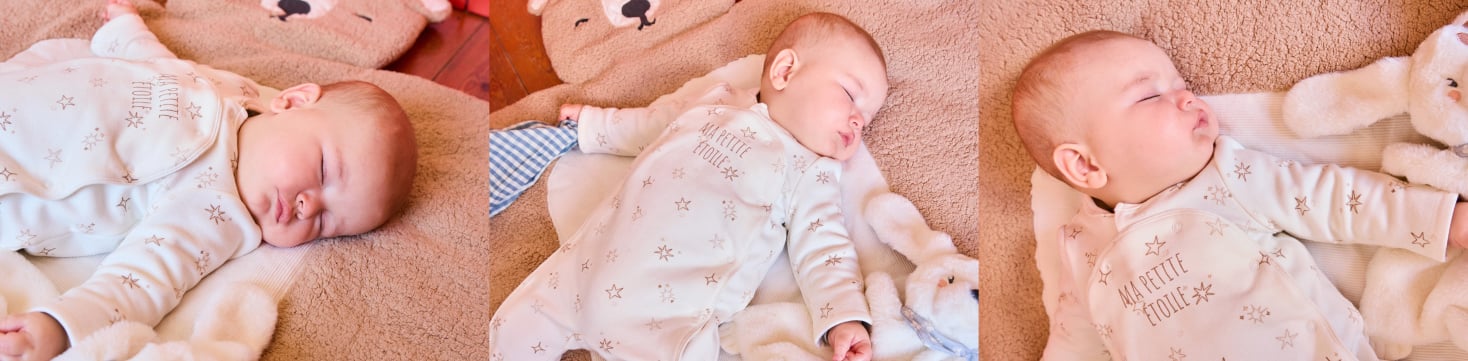
It's 9 pm.
Bedtime has arrived, and your little one is making sure you know it.
To help them settle, you gently close the curtains, dim the lights, little eyes begin to rub, and those final cuddles become part of the bedtime routine. In just a few moments, they'll drift off, either snuggled up to their comforter or somehow lying at the opposite end of the cot, because babies have their own rules. 😄
And yet, in a matter of seconds, a thousand questions race through your mind. Is a bodysuit enough? Should you add sleepsuit? Is this sleeping bag the right one? What if you've dressed them too warmly… or not warmly enough?
Because really, all you want is for your baby to sleep comfortably through the night without turning bedtime into an escape room challenge.
Not to mention trying to fasten poppers in the dark while your baby is already starting to lose patience.
Sometimes, you just wish your baby could whisper exactly what they need.
Think of this guide as that little whisper. Simple, practical advice to help you dress your baby for bedtime with confidence, whatever the situation.
A few essentials, a couple of minutes, and your little one is all set for a cosy night's sleep. All that's left to do is wish them sweet dreams... and hope you get to enjoy yours too. 😄
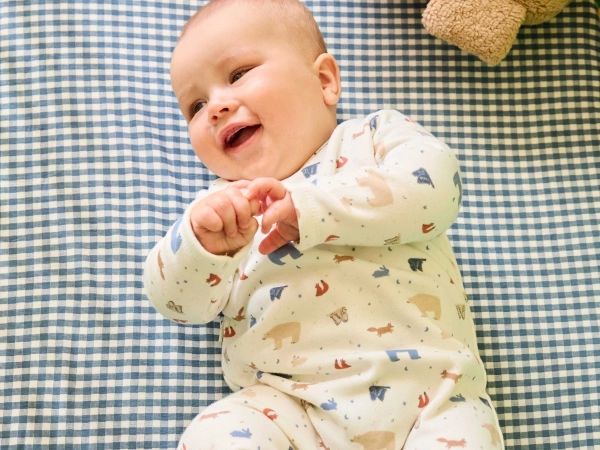
Getting bedtime sorted (without overthinking it)
The dream team that keeps your baby comfortable while you get some sleep (hopefully):
- The bodysuit: the foundation. The one that stays put, no matter how much wriggling happens overnight.
- The sleepsuit: the layer you adapt to the room temperature.
- The sleeping bag: the official bedtime essential. Unlike a blanket, it won't end up on the floor at 2 am... or over your baby's face.
Think of them as the perfect trio: each has its own role, and together they help your baby sleep comfortably all night long. 😄
So, the team is complete... but when should each one come into play?
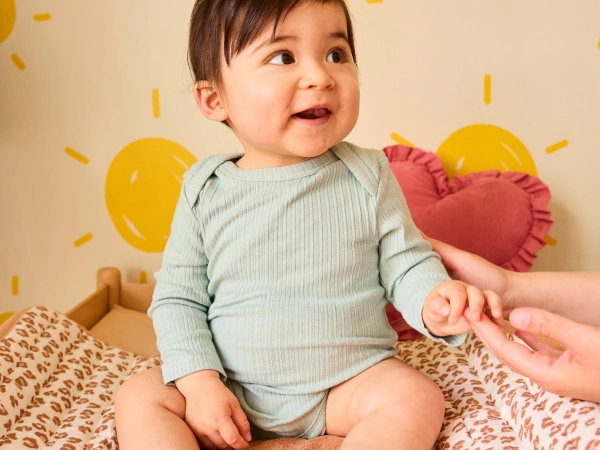
Baby bodysuits: the one you put straight back on after washing
Where's that bodysuit? Where has it gone?
You know... that one.
There's always one bodysuit you reach for first.
The one that fits just right. The one that stays perfectly in place. The one you end up buying in another colour because, well, one simply isn't enough.
- It helps absorb moisture while your baby sleeps.
- It provides a comfortable base layer throughout the night.
- It stays in place, even when your little one decides bedtime is the perfect time for gymnastics.
Short sleeves or long sleeves depending on the room temperature, it's the bedtime essential you'll always come back to.
A long-sleeved cotton bodysuit is a reliable choice when the room is around 20°C. And ribbed styles? Don't be surprised if they quickly become your bedtime favourite.
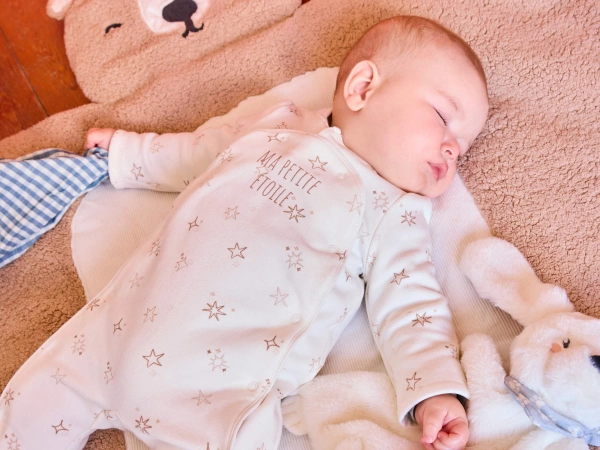
Baby sleepsuits: the unsung hero of night-time wake-ups
Ah, the sleepsuit.
The one you search for in the dark. The one you put on with one eye open while the other is still deciding whether to join in. The one that needs to open fast because nappy leaks don't wait for anyone.
The ideal baby sleepsuit looks a little like this:
- Soft, flexible fabric so your baby can wriggle comfortably.
- Easy fastenings, because middle-of-the-night changes rarely happen with both eyes open.
- A fabric that's gentle on delicate skin and suitable for the room temperature.
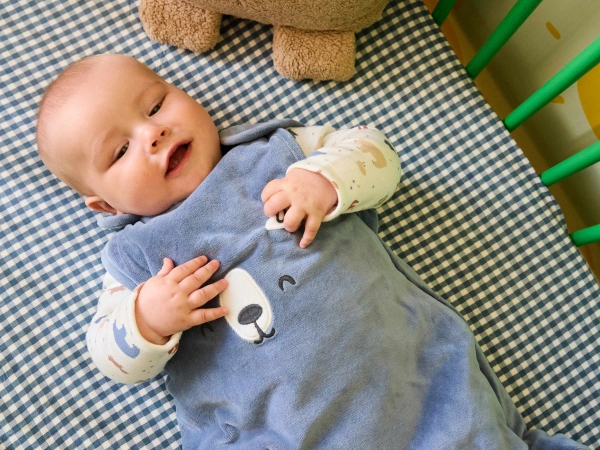
When the bedroom stays around 20–21°C, a lightweight cotton sleepsuit is usually just right. As soon as those early mornings start to feel a little cooler, cosy velour sleepsuits quietly earn their place back in the bedtime routine.
Baby sleeping bags: no more bedtime guesswork
There's a moment in the night when someone whispers:
"Are they warm enough? Are they sleeping comfortably?"
At this point, you should probably be asleep too. But instead, your brain has decided it's time for an emergency meeting about your baby's sleeping bag.
A baby sleeping bag helps keep your little one at a comfortable temperature throughout the night, especially when the bedroom cools down in the early hours.
We all have that sleeping bag that goes straight back into the bedtime rotation as soon as it's dry. You know the one. 😄
By the way, let's clear up one thing straight away: whether you call it a sleeping bag or a sleep sack, it's exactly the same thing. 😉
And if your next question is, "OK, but which TOG rating should I choose for the room temperature?", we've put together a handy guide to help you find the right one without second-guessing yourself every evening.
How should you dress your baby at night according to the room temperature?
Real-life bedtime moments. Find yours.
🌡️ 24°C and above: "Let's keep things cool"
- Short-sleeved bodysuit
- A lightweight sleepsuit, or just the bodysuit if your baby's neck feels warm and dry.
- Ultra-lightweight baby sleeping bag
The less you need, the better everyone sleeps.
🌙 22–24°C: warm, comfortable nights
- Short-sleeved or lightweight long-sleeved bodysuit
- Lightweight sleepsuit
- Lightweight baby sleeping bag
The "everyone's happy" combination.
🍃 20–22°C: when the weather can't quite make up its mind
- Long-sleeved bodysuit
- Lightweight sleepsuit
- Mid-weight baby sleeping bag
It might make you hesitate. Your baby probably won't.
🏡 18–20°C: the reliable favourite
- Long-sleeved bodysuit
- Cotton sleepsuit
- Baby sleeping bag with the right TOG rating
The trio waiting on the changing table before bath time. The one you reach for without even thinking.
🍂 16–18°C: there's a definite chill in the air
- Long-sleeved bodysuit
- Warmer sleepsuit
- Warmer baby sleeping bag
Time for velour to make its comeback. And honestly, there's a reason it's a favourite.
❄️ 14–16°C: winter mode
- Long-sleeved bodysuit
- Velour sleepsuit
- Warm baby sleeping bag
Your baby is ready. So are you.
🧊 Below 14°C: extra cosy mode
- Long-sleeved bodysuit
- Warm sleepsuit
- Extra-warm baby sleeping bag
That's when you can finally think, "Right, we're all set."
How can you tell if your baby is too hot or too cold at night?
Signs your baby is too warm
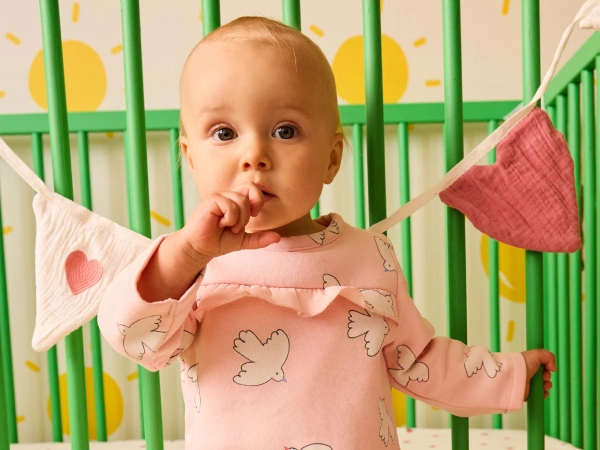
- A warm, clammy neck
- Flushed cheeks or skin
- Restlessness or frequent waking
- Sweating around the neck or scalp
A warm, clammy neck usually means your baby is wearing one layer too many. Removing a layer often helps them feel more comfortable.
Signs your baby is too cold
- A cool neck
- Frequent waking
- Your baby curls up, bringing their knees towards their tummy
How to check
Place your hand gently between your baby's shoulder blades for around ten seconds.
- Warm and clammy → remove a layer.
- Warm and dry → perfect.
- Cool → add a layer.
And cold hands? They're just doing their job. Your baby's neck is always the best place to check.
What is the ideal room temperature for your baby's bedroom?
Between 18°C and 20°C. That's the sweet spot for a comfortable night's sleep – for your baby and for you.
A room thermometer is one of those small purchases that can make bedtime much easier. The temperature in the hallway can easily be 2–3°C warmer than your baby's bedroom, and when the heating switches off in the evening, the room temperature may drop by 3–5°C before morning.
How should you dress your baby at night in winter and summer?
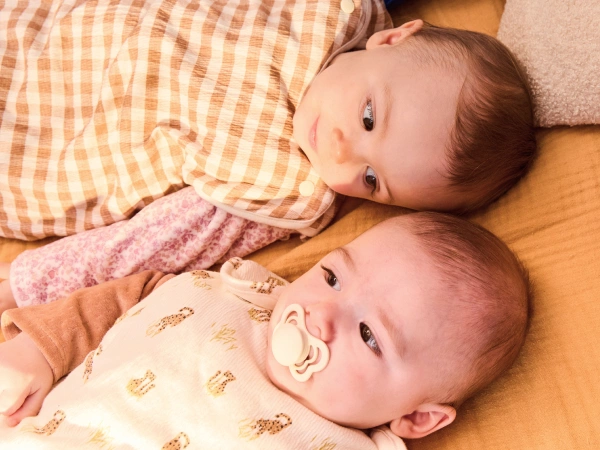
Dressing your baby for sleep in winter
The biggest challenge in winter is the temperature drop between bedtime and the early hours of the morning. The heating goes off, and the bedroom gradually gets cooler.
A 2.5 or 3 TOG baby sleeping bag is usually the best choice, depending on how well your home is insulated. Pair it with a long-sleeved bodysuit and a suitable sleepsuit. If your home stays warm throughout the night, a 2 TOG sleeping bag is often enough.
Dressing your baby for sleep in summer
In summer, the bedroom often holds onto the day's warmth. A short-sleeved bodysuit with a 0.5 TOG baby sleeping bag is usually ideal. When the room temperature rises above 24°C, a bodysuit on its own may be enough.
Keep the curtains closed during the day and open the windows at night once the temperature drops outside. It's simple, it doesn't cost a thing, and it really works.
Tips for dressing your baby safely at night
Why shouldn't you overdress your baby?
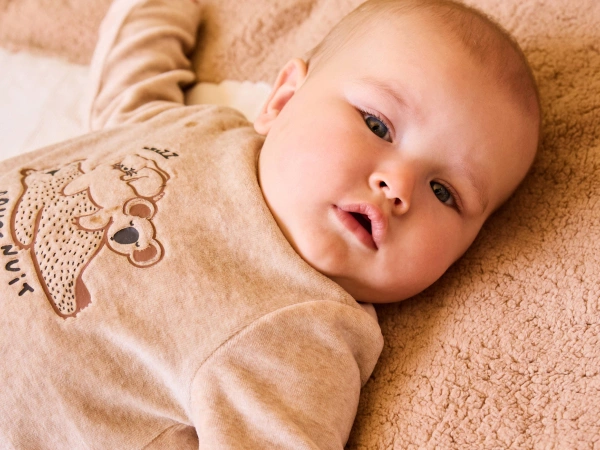
Babies don't regulate body temperature as efficiently as adults. Too many layers can lead to overheating, sweating and restless nights. When in doubt, it's usually better to dress your baby a little lighter and check the back of their neck.
Safe sleep recommendations
- A baby sleeping bag is the only bedding your baby needs before the age of two. It stays securely in place all night, even when your little one wriggles around.
- Keep pillows, cot bumpers and oversized soft toys out of the cot. A clear sleep space is the safest place for your baby.
- Always put your baby to sleep on their back until they can roll over by themselves.
- Your baby doesn't usually need to wear a hat indoors at night. They naturally release some of their body heat through their head.
Bedtime FAQ
Can my baby sleep in just a bodysuit?
Yes, when the room temperature is 26°C or above. A room thermometer makes it easy to choose the right sleepwear with confidence.
Does my baby have to wear a sleepsuit?
Not necessarily. It all depends on the room temperature, the TOG rating of the sleeping bag and the balance you're aiming for. You know your baby better than anyone — these guidelines are simply here to help.
Why are my baby's feet cold?
That's perfectly normal. Babies don't keep their hands and feet warm all the time — it's part of the way they regulate their body temperature. The back of the neck tells you far more than their feet.
Do I need to change everything every night?
Usually, adjusting just one layer is enough. No need for a complete bedtime wardrobe change every evening. 😄
How can I dress my baby for sleep without a sleeping bag?
A well-fitting sleepsuit can be a temporary solution. Before the age of two, however, a baby sleeping bag remains the safest choice because it stays securely in place, whatever position your baby sleeps in.
What is TOG?
TOG stands for Thermal Overall Grade. It's the standard rating used to choose a baby sleeping bag according to your baby's room temperature.
Should I choose a baby sleeping bag or a baby nest for night-time sleep?
A baby nest is designed for supervised use or carrying your baby, not for overnight sleep. A baby sleeping bag stays securely in place, whatever position your baby sleeps in.
Bedtime is all about adapting to real life.
Bedroom temperatures change, babies grow, and no two evenings are ever quite the same. But when the bodysuit, sleepsuit and baby sleeping bag work together, you're already off to a great start.
Explore our other guides
- Maternity bag: what to pack for the birth
- Baby sleep: understanding it to better support your little one
- TOG explained: choosing the right baby sleeping bag for your baby's room temperature
- Baby ponchos: travel, bath or beach – which one should you choose?
- How to choose the right coat, puffer jacket or jacket for your child